Updated December 2025
As a Canadian eye care professional, you play a critical role in ensuring road safety across Ontario. The Ministry of Transportation (MTO) sets strict guidelines for visual acuity, peripheral vision, and Ontario’s visual field requirements for drivers. Accurate testing and documentation, especially using the Esterman visual field test, are essential for helping drivers maintain safe driving privileges and meet provincial licensing standards.
This guide breaks down Ontario’s visual field requirements for driving, explains when a driving vision test is required, clarifies how the vision waiver program works, and shows how the Carrot Visual Diagnostics Platform helps you efficiently conduct MTO-valid Esterman tests, including for senior drivers, monocular patients, and commercial license applicants.
MTO Vision Standards for Drivers
Ontario has some of the most clearly defined visual field requirements for driving in Canada. Testing protocols vary depending on license class, medical status, patient age, and whether a driver requires medical review.
Below is a breakdown of Ontario’s visual field requirements and what you must understand when completing the MTO vision report.
When Vision Tests Are Required in Ontario
You will perform a vision test for an Ontario driver’s license in any of the following scenarios:
1. New license applicants
All new drivers must complete a Service Ontario vision test before receiving a G, M, A, B, C, D, E, or F license.
2. Mandatory vision test for senior drivers (age 80+)
Ontario requires a vision screening every two years once a driver turns 80. Seniors must complete:
- A vision test for senior drivers in Ontario
- A knowledge test
- A Group Education Session (GES)
- Possible in-car evaluation depending on results
3. Medical review
A medical referral triggers a visual field test for driving when a patient has:
- Glaucoma
- Cataracts
- Retinal disease
- Optic neuropathy
- Neurological vision loss
- Monocular vision
Patients often search for “can you drive with one eye in Ontario?” The answer is yes, but only if they meet the vision waiver program Ontario requirements.
4. Post-incident review
After certain accidents or police reports, the MTO may require an updated MTO vision report or MTO medical form.
5. Following MTO guideline updates
The province updates its vision standards for driving, especially as new technologies and safety research emerge.

Ontario’s Visual Field Requirements for Driver Licensing
Ontario’s minimum vision requirements for driving vary by license class.
Non-Commercial Licenses (G, M)
| Requirement | Minimum Standard |
|---|---|
| Visual Acuity | 20/50 or better in the better eye |
| Horizontal Visual Field | At least 120°, with 15° above and 15° below fixation |
| Field Test Type | Esterman or equivalent binocular field |
Commercial Licenses (A, B, C, D, E, F)
| Requirement | Minimum Standard |
|---|---|
| Visual Acuity | 20/30 in the better eye AND at least 20/100 in the weaker eye |
| Horizontal Visual Field | At least 150°, with 20° above and 20° below fixation |
| Color Vision | Required for certain licenses |
What Is the Vision Test for a Driver’s License in Ontario?
Ontario requires both visual acuity testing and a visual field test. For field testing, the Esterman visual field test is the most commonly used tool because it evaluates real-world, functional binocular vision.
Understanding Ontario’s Visual Field Requirements
The MTO accepts binocular Esterman visual field testing for most driver evaluations. This exam measures horizontal extent, detects central and peripheral defects, and provides quantifiable data for determining fitness to drive.
Key MTO visual field requirements:
- Must demonstrate at least 120° horizontal field for standard licenses
- Must demonstrate at least 150° horizontal field for commercial licenses
- Must show adequate superior and inferior sensitivity
- Must document scotomas or neurological deficits when present
What Is the Vision Waiver Program in Ontario?
Drivers who do not meet standard MTO vision thresholds may still qualify to drive under the Vision Waiver Program Ontario.
The waiver is designed for patients with conditions such as:
- Monocular vision
- Hemianopia
- Quadrantanopia
- Other stable field defects
To qualify, patients must:
- Demonstrate a safe driving history
- Provide Esterman field test results
- Submit the MTO vision waiver form or vision waiver renewal Class G form
- Undergo functional assessment if required
MTO Documentation and Reporting Requirements

Eye care professionals must complete the MTO vision report and comply with:
- Highway Traffic Act (HTA)
- Personal Health Information Protection Act (PHIPA)
- Accessibility for Ontarians with Disabilities Act (AODA)
Documentation may include:
- Esterman binocular visual field results
- Medical report forms
- Acuity update after cataract surgery
- Field of vision test for driving results
- Supporting diagnostic evidence
How Carrot Helps Meet MTO Requirements
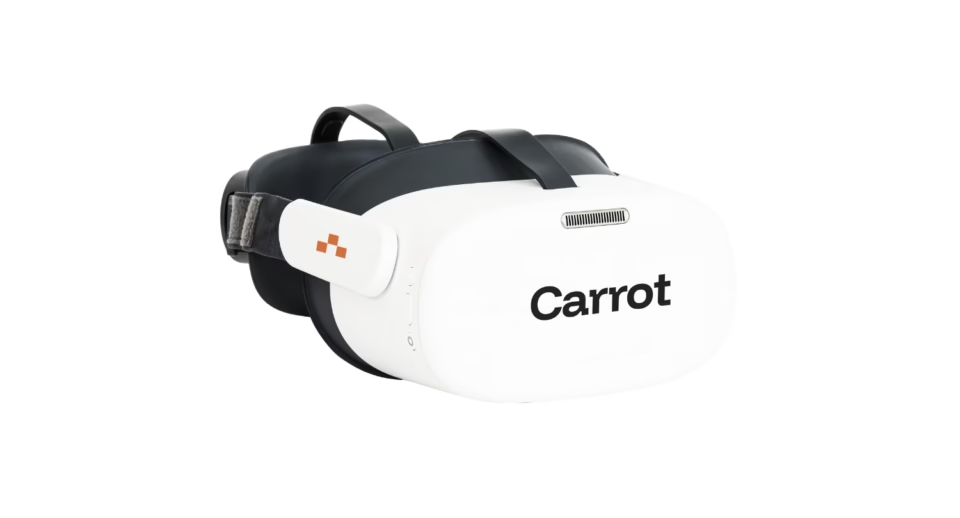
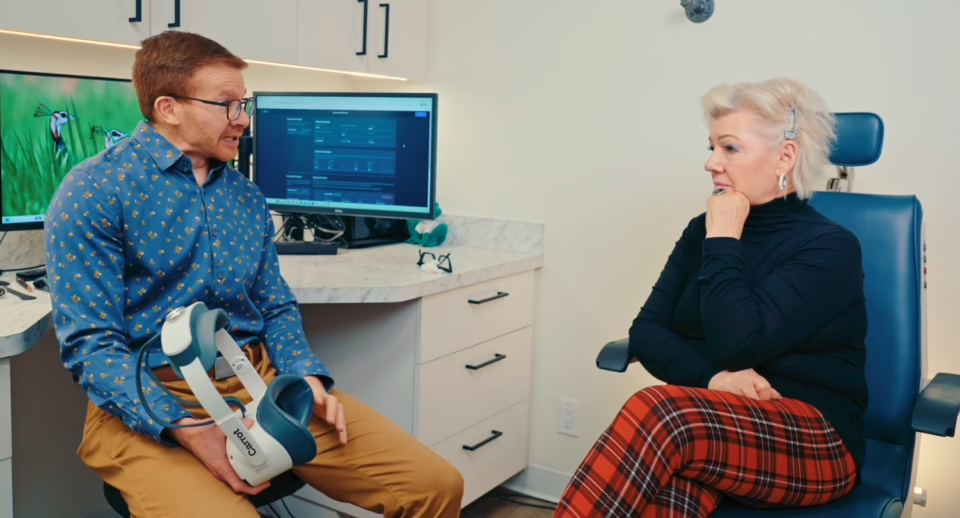
Carrot provides fast, accurate, MTO-valid Esterman visual field exams, making it easier for Canadian practices to meet regulatory standards while improving workflow and patient comfort.
Why Canadian Eye Care Professionals Choose Carrot
Fully Compatible With MTO Requirements. Carrot performs MTO-approved Esterman visual field tests, including horizontal field measurement for both non-commercial and commercial license applicants.
Health Canada Licensed (MDL) Both VF3 Pro and VF3 Basic hold Canadian Medical Device Licenses and supports OHIP and provincial billing codes.
Ideal for Rural and Remote Ontario. With 2.5 million rural residents, access matters. Carrot only requires:
- WiFi
- A tablet or laptop
- A headset
- No dark room. No bowl perimeter. No clinic expansion.
Accessible to Patients With Disabilities and ideal for:
- Seniors (Ontario’s fastest-growing demographic of license renewals)
- Mobility-restricted patients
- Patients sensitive to chin-rest positioning
Supports 41 Languages. Ideal for Ontario’s multicultural population.
Fast, Precise Exams. Includes:
- Esterman
- 24-2
- Kinetic Goldmann
- Ptosis (Superior 36)
- Color vision (Ishihara color plates)
- Pupillometry
- Extraocular motility (EOM)
Better Vision Field Testing Leads to Safer Ontario Roads
The MTO’s rules can feel complex, but your workflow doesn’t have to be. Carrot provides Ontario clinicians with:
- MTO-valid Esterman testing
- Simplified documentation
- Accessibility for seniors and rural populations
- Reliable, repeatable results that support safe licensing decisions